Pourquoi les échantillons de fonte doivent-ils être refroidis rapidement et soumis immédiatement à une analyse spectroscopique ?
De nombreux services de contrôle qualité des fonderies appliquent une règle stricte : après l'échantillonnage, la fonte doit être rapidement refroidie afin de terminer le processus de formation de la fonte blanche , puis être polie jusqu'à obtenir une surface lisse et immédiatement soumise à une analyse spectroscopique. Le refroidissement à l'air et les tests ultérieurs sont strictement interdits. De nombreux nouveaux opérateurs considèrent ce processus comme redondant et excessivement strict, mais cette procédure opérationnelle standard est essentielle pour garantir une analyse précise de la composition du fer et éviter la mise au rebut massive de fours entiers de pièces moulées. La logique sous-jacente est simple : une analyse spectroscopique précise nécessite une structure de fonte blanche uniforme et dense. Tout échantillon de fonte grise contenant du graphite précipité produira des données déformées et invalides.
1. Refroidissement rapide : « figer » l'échantillon dans un état de fonte blanche détectable.
La fonte elle-même présente une teneur élevée en carbone et silicium , qui sont tous deux des composants clés favorisant la précipitation du graphite. Si l'échantillon est refroidi naturellement à l'air, la faible vitesse de refroidissement laisse suffisamment de temps aux atomes de carbone du fer en fusion pour diffuser et s'agréger, précipitant finalement du graphite libre lamellaire ou sphéroïdal et formant la structure courante de la fonte grise. Le graphite, étant un matériau isolant non métallique, est dispersé dans une matrice métallique et perturbe directement la conductivité uniforme de la surface de l'échantillon. La détection spectroscopique repose sur une excitation stable par étincelles et l'acquisition de données de luminescence du plasma ; les îlots isolés de graphite isolant provoquent des perturbations de décharge et une diffusion d'énergie, rendant impossible l'obtention de signaux spectraux standards.
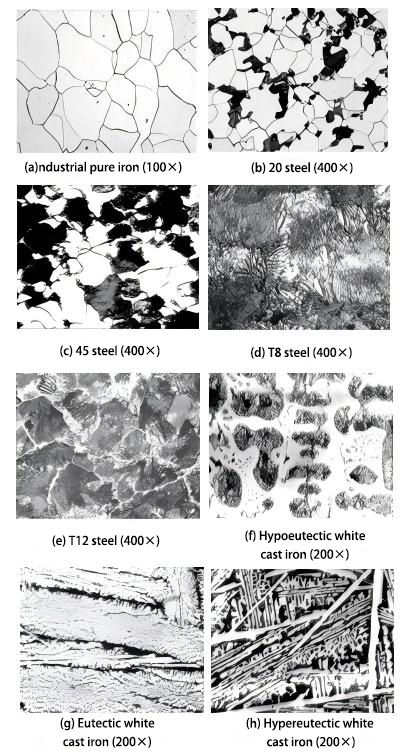
Seule l'utilisation d'un moule spécialisé en cuivre pour un refroidissement rapide combiné à un refroidissement à l'eau permet de supprimer de force la diffusion et la précipitation des atomes de carbone, interrompant ainsi le processus de formation du graphite. À ce stade, le carbone contenu dans le fer en fusion ne peut pas précipiter sous forme de graphite libre ; il se combine plutôt avec le fer pour former de la cémentite, qui est uniformément répartie dans la matrice métallique sous forme de carbone combiné, formant finalement un échantillon de fonte blanche à grains fins, composition uniforme et microstructure cohérente. Cette microstructure de fonte blanche sans graphite et à conductivité uniforme correspond parfaitement à la référence d'étalonnage des normes spectrales , et constitue la seule condition fondamentale pour des données de détection spectrale précises.
2. La mesure doit être effectuée immédiatement : la précipitation du graphite est irréversible.
De nombreux opérateurs d'atelier ont une idée fausse : tant que l'échantillon est rapidement refroidi et formé lors de l'échantillonnage, il est conforme, et peu importe le temps avant l'analyse. En réalité, le processus de graphitisation des échantillons de fonte est continu et irréversible. Même après le refroidissement et la solidification de l'échantillon, alors que la surface semble être en fonte blanche, la chaleur résiduelle interne continue de favoriser la réaction de graphitisation à l'état solide. Après un court temps de repos, une grande quantité de graphite fin latent précipite ; celui-ci peut ne pas être clairement visible à l'œil nu, mais il interfère directement avec la détection spectrale. Une fois que des impuretés de graphite sont générées, des problèmes de détection typiques apparaissent : excitation instable par étincelles, taches lumineuses diffuses, valeurs significativement faibles pour l'élément carbone principal, ainsi que de grandes fluctuations et imprécisions des données pour des éléments d'alliage clés tels que le silicium, le manganèse et le phosphore.
En outre, les échantillons de fonte fraîchement formés à haute température sont extrêmement réactifs. Une exposition prolongée à l'air génère rapidement une couche d'oxyde dense à la surface. Cette couche d'oxyde non seulement isole et bloque la conductivité, mais absorbe également l'énergie d'excitation par étincelles , ce qui aggrave encore les erreurs de détection. Par conséquent, les opérations standardisées en atelier exigent qu'après le refroidissement rapide, le retrait de l'échantillon et le meulage destiné à éliminer la couche d'oxyde superficielle et les bavures, l'échantillon soit immédiatement soumis à un test spectral afin de minimiser les écarts de données causés par les changements de microstructure et l'oxydation de surface.
3. Des données inexactes sont à l'origine des mises au rebut massives.
Les tests spectraux avant le four constituent la « première ligne de contrôle qualité » dans la production de pièces moulées. Leur fonction principale est de détecter rapidement la composition réelle du fer en fusion, d'étalonner avec précision l'équivalent carbone et de permettre aux techniciens d'ajuster en temps réel le dosage et le processus de fusion. Si les processus de refroidissement rapide et de test immédiat sont omis, des données de composition déformées seront obtenues. Les opérateurs ajustant la charge du four et la température sur la base de données incorrectes entraîneront directement une composition non conforme de l'ensemble du four de fer en fusion. Les pièces moulées suivantes seront fortement exposées à une série de défauts de qualité tels qu'une dureté anormale, des propriétés mécaniques insuffisantes, une porosité de retrait et une fragilité, ce qui entraînera finalement la mise au rebut de tout le lot de produits et augmentera considérablement les coûts de production ainsi que les pertes de temps.
Le principe fondamental de l'échantillonnage spectral avant four dans la fonderie est le suivant : refroidissement rapide pour préserver la structure de fonte blanche, et test immédiat pour garantir la précision. Voici une distinction essentielle : nos pièces moulées en fonte finies nécessitent un refroidissement lent contrôlé afin de précipiter le graphite, améliorant ainsi la ténacité et l'usinabilité de la pièce moulée ; cependant, les échantillons avant four utilisés pour les tests spectraux doivent être traités de manière opposée, en utilisant un refroidissement rapide pour verrouiller une structure uniforme de fonte blanche, et le test doit être effectué immédiatement après la formation. Le respect strict de ce processus standardisé est essentiel pour garantir la précision et la validité des données de chaque test de composant, maintenant ainsi la qualité des pièces moulées produites.
Veuillez nous contacter pour toute demande supplémentaire ou pour obtenir des informations détaillées !
Tél. :+86-183-5283 6805
E-mail :sales@jinyibo.com
Site Web :www.jinyibo.com