Fusion sous gaz inerte (IGF) vs. extraction à chaud : différences clés dans l'analyse des éléments gazeux
En science des matériaux et en métallurgie, la fusion sous gaz inerte (IGF) (souvent normalisée sous le nom de fusion-extraction sous gaz inerte) et l'extraction à chaud (également appelée désorption thermique ou TDS/TDA) sont les deux principales méthodes analytiques utilisées pour déterminer les impuretés gazeuses interstitielles — spécifiquement l'oxygène (O)/l'azote (N)/l'hydrogène (H)— dans des échantillons solides tels que les métaux, les alliages, les céramiques avancées et les poudres inorganiques.
La différence fondamentale entre ces deux méthodes réside dans l'état physique de l'échantillon pendant le chauffage et dans la température d'extraction.
En termes simples: La fusion sous gaz inerte fait fondre complètement l'échantillon afin de libérer tous les gaz par des réactions chimiques, tandis que l'extraction à chaud chauffe l'échantillon en dessous de son point de fusion pour extraire uniquement l'hydrogène diffusible par diffusion à l'état solide.
1. Principes fondamentaux et mécanismes de libération des gaz
Fusion sous gaz inerte (IGF)
État de l'échantillon: Complètement fondu (transition de phase solide-liquide).
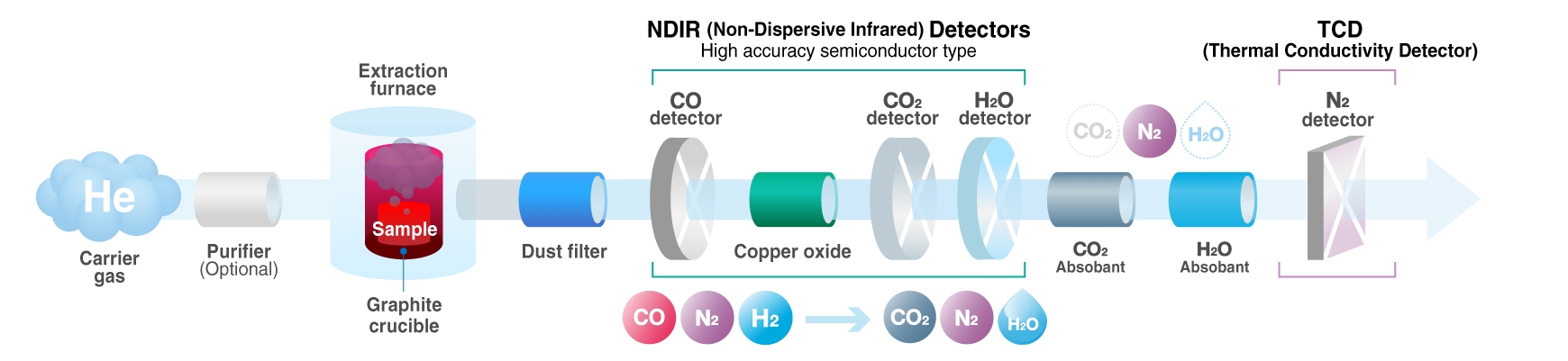
Principe de fonctionnement : L'échantillon est placé dans un creuset en graphite de haute pureté sous un flux protecteur de gaz vecteur inerte (généralement de l'hélium, He, ou de l'argon, Ar). Il est ensuite chauffé à des températures ultra-élevées (1500℃ à 3000℃) à l'aide d'un four à impulsions (chauffage par résistance d'électrode) ou d'un four à induction haute fréquence.
Mécanisme de libération des gaz: À ces températures extrêmes, le réseau cristallin du matériau est complètement détruit. L'oxygène combiné dans l'échantillon subit une réaction de réduction carbothermique avec le carbone du creuset en graphite, générant du monoxyde de carbone (CO). Simultanément, l'azote et l'hydrogène piégés dans les interstices du réseau, les défauts ou les inclusions sont entièrement libérés sous forme de molécules N2 et H2. Le gaz vecteur entraîne ensuite ces gaz libérés vers le système de détection.
Détecteurs et éléments ciblés: Équipé de détecteurs infrarouges non dispersifs (NDIR) pour mesurer l'oxygène (souvent après conversion du CO en CO2 via un catalyseur à base d'oxyde de cuivre) et de détecteurs de conductivité thermique (TCD) pour mesurer l'azote et l'hydrogène. Il mesure simultanément et précisément l'oxygène total (Total O), l'azote total (Total N) et l'hydrogène total (Total H).
Extraction à chaud
État de l'échantillon: À l'état solide pendant tout le processus. La structure cristalline reste intacte et la température de chauffage est maintenue strictement en dessous du point de fusion de l'échantillon.
Principe de fonctionnement: Par un chauffage à basse ou moyenne température (soit isotherme, soit par désorption programmée en température), le mouvement thermique et le taux de diffusion interstitielle des atomes d'hydrogène dans le réseau sont considérablement augmentés. Cela permet à l'hydrogène diffusible (hydrogène mobile) de migrer vers la surface de l'échantillon et de se désorber. Le H2 libéré est transporté par un gaz vecteur de haute pureté (tel que l'argon ou l'azote) vers le détecteur.
Mécanisme de libération des gaz: En raison des températures de fonctionnement plus basses, cette méthode ne peut pas rompre les liaisons chimiques fortes, ce qui signifie qu'elle ne peut pas décomposer les inclusions d'oxyde ou de nitrure très stables. Par conséquent, elle ne permet absolument pas de détecter l'oxygène ou l'azote. À des températures plus élevées (800℃-1100℃) lors des essais programmés en température, elle peut extraire l'hydrogène piégé faiblement lié aux joints de grains et aux défauts (appelé hydrogène résiduel). Cependant, sa cible principale reste l'hydrogène (H).
Détecteurs et éléments ciblés: Utilisant des détecteurs de conductivité thermique (TCD) de haute précision ou des détecteurs de spectrométrie de masse (MS) conçus spécifiquement pour l'analyse de l'hydrogène.
2. Comparaison technique : IGF vs. extraction à chaud
|
Caractéristique / Dimension
|
Fusion sous gaz inerte (IGF)
|
Extraction à chaud
|
|
Température de fonctionnement
|
Ultra-élevée : 1500℃ à 3000℃
(par ex., 1800℃-2200℃ pour l'acier ; 2600℃-3000℃ pour les métaux réfractaires comme le titane et les carbures)
|
Modérée : 400℃ à 1100℃ (par ex., l'essai standard de l'hydrogène diffusible est isotherme à 400℃ ; toujours strictement inférieur au point de fusion de l'échantillon)
|
|
État de l'échantillon
|
Complètement fondu (liquide)
|
État solide intact (solide)
|
|
Mécanisme de libération des gaz
|
Destruction du réseau + réduction carbothermique (réaction chimique)
|
Diffusion atomique thermique à l'état solide (désorption physique)
|
|
Éléments cibles
|
Tout-en-un : Oxygène total (O), Azote total (N), et Hydrogène total (H)
|
Axé sur l'hydrogène : principalement l'hydrogène diffusible ; peut mesurer l'hydrogène résiduel à faible liaison
|
|
Agents de flux (par ex., Ni, Sn, Cu)
|
Fréquemment requis pour abaisser le point de fusion du bain, accélérer la dissolution du carbone et assurer une libération complète des gaz
|
Aucun requis
|
|
Temps d'analyse
|
Très efficace : 3 à 5 minutes par échantillon
|
Dépendant de la diffusion : ~30 minutes pour l'hydrogène diffusible ; 1 à 3 heures pour l'extraction de l'hydrogène résiduel
|
|
Système de détection
|
NDIR (pour l'oxygène) + TCD (pour l'azote et l'hydrogène)
|
TCD ou spectrométrie de masse (MS) (dédié à l'hydrogène)
|
|
Principales normes industrielles
|
ASTM E1019, ISO 15351, GB/T 223.89 (Méthodes standard pour la détermination totale de O, N, H)
|
ISO 3690, GB/T 3965, GB/T 38939 (Méthodes standard pour l'hydrogène diffusible/de soudage)
|
3. Pourquoi l'extraction à chaud ne peut pas détecter l'oxygène et l'azote
La raison fondamentale de cette limitation réside dans la différence entre l'énergie de liaison et les caractéristiques de diffusion de ces atomes gazeux au sein de la matrice métallique :
Comportement de l'hydrogène (H): Les atomes d'hydrogène ont un rayon atomique extrêmement petit et se trouvent sous forme d'atomes interstitiels dans le réseau métallique, ce qui entraîne une énergie d'activation de diffusion exceptionnellement faible. Même à température ambiante, l'hydrogène peut diffuser spontanément ; à des températures modérées comme 400℃, il migre rapidement à travers les sites interstitiels du réseau et se désorbe de la surface. Ainsi, il est facilement quantifié par extraction à chaud.
Comportement de l'oxygène (O) et de l'azote (N): L'oxygène et l'azoteexistent dans les métaux et les céramiques sous forme d'inclusions chimiquement liées et thermodynamiquement stables (telles que l'alumine, Al2O3, ou le nitrure de titane, TiN). L'énergie de liaison de ces composés est extrêmement élevée, et un chauffage modéré à l'état solide ne peut pas fournir suffisamment d'énergie pour rompre ces liaisons. De plus, comme leurs rayons atomiques sont significativement plus grands que celui de l'hydrogène, leurs coefficients de diffusion dans les réseaux à l'état solide sont pratiquement négligeables.
Aperçu technique: Seul l'environnement à ultra-haute température de la fusion sous gaz inerte peut faire fondre la matrice et dissoudre le carbone du creuset en graphite dans un bain de métal liquide (souvent assisté par des fondants à base de nickel ou d'étain). Cet environnement en phase liquide permet une réaction rapide de réduction carbothermique qui décompose les oxydes stables pour libérer du CO gazeux et décompose les nitrures pour libérer du gaz N2, permettant une extraction complète et quantitative.
4. Applications typiques et directives de sélection
Quand utiliser la fusion sous gaz inerte (IGF)
Applications: Détermination de la teneur totale en impuretés gazeuses dans l'acier, les métaux non ferreux, les alliages de titane/zirconium, les carbures cémentés, les céramiques avancées, les poudres de cathode pour batteries au lithium et les cibles de pulvérisation de haute pureté.
Objectif: Essentiel pour le contrôle qualité des matières premières, la vérification de la pureté chimique globale et l'identification des inclusions non métalliques. Elle sert de norme universelle pour les transactions commerciales et les arbitrages académiques.
Sortie des données: O total, N total et H total.
Quand utiliser l'extraction à chaud
Applications: Ciblant spécifiquement l'hydrogène diffusible pour évaluer les risques de dégradation des matériaux, tels que la fragilisation par l'hydrogène (HE) et la fissuration retardée dans les aciers à haute résistance, les consommables de soudage (analyse de l'hydrogène dans le métal soudé), les lingots d'alliage d'aluminium ou les analyses de défaillance liées à la charge en hydrogène des alliages de titane.
Objectif: Évaluation des risques hautement spécialisée. Comme elle est non destructive pour la macrostructure de l'échantillon, elle fournit des prévisions très précises de la durée de vie réelle en service concernant les dangers liés à l'hydrogène actif.
Sortie des données: Hydrogène diffusible (hydrogène mobile) et hydrogène résiduel/piégé.
5. Résumé et points clés pour l'approvisionnement des laboratoires
Pour une analyse complète des éléments: Si votre laboratoire a besoin de données certifiées et faisant autorité sur la concentration totale d'oxygène, d'azote et d'hydrogène afin de respecter les normes mondiales de contrôle qualité, vous devez utiliser la fusion sous gaz inerte (IGF).
Pour la fragilisation par l'hydrogène et l'analyse des défaillances: Si votre objectif principal est d'évaluer les facteurs de risque tels que la fissuration induite par l'hydrogène sans détruire la géométrie des composants, l'extraction à chaud est la méthodologie idéale et hautement spécialisée.
Non-équivalence des données: Les résultats analytiques de ces deux méthodes ne peuvent pas être utilisés de manière interchangeable. Le "Hydrogène total" mesuré par IGF comprend l'hydrogène piégé, moléculaire et lié aux composés, donnant des valeurs nettement supérieures à l'« hydrogène diffusible » mobile obtenu par extraction à chaud. Chacun représente une dimension entièrement différente des performances du matériau.
FAQ 1 : La fusion sous gaz inerte (IGF) peut-elle remplacer l'extraction à chaud pour l'évaluation du risque de fragilisation par l'hydrogène ?
Réponse : Non. L'IGF mesure l'hydrogène total dans les échantillons, y compris l'hydrogène diffusible, l'hydrogène résiduel piégé et l'hydrogène lié chimiquement. Cependant, seul l'hydrogène diffusible est la cause directe de la fragilisation par l'hydrogène et de la fissuration retardée dans les matériaux métalliques. Comme l'IGF ne peut pas différencier l'hydrogène diffusible de l'hydrogène total et nécessite la fusion de l'échantillon, elle ne peut pas évaluer indépendamment le risque de fragilisation par l'hydrogène. En revanche, l'extraction à chaud isole et quantifie spécifiquement l'hydrogène diffusible par un chauffage à l'état solide sans fusion, ce qui en fait la méthode standard de l'industrie pour l'évaluation de la fragilisation par l'hydrogène et les essais de conformité de l'hydrogène dans les soudures.
FAQ 2 : Pourquoi les essais IGF nécessitent-ils des agents fondants alors que l'extraction à chaud n'en nécessite pas ?
Réponse : L'IGF repose sur une fusion à ultra-haute température et une réduction carbothermique pour extraire tous les éléments gazeux. Les agents fondants (tels que le nickel, l'étain ou le cuivre) abaissent la température du liquidus de la fusion, favorisent la dissolution uniforme du carbone provenant du creuset en graphite et accélèrent la décomposition complète des oxydes et nitrures stables afin d'assurer une libération totale des gaz. L'extraction à chaud, quant à elle, repose uniquement sur la diffusion thermique physique de l'hydrogène à travers la matrice solide sans fusion ni réactions chimiques, ce qui rend les agents fondants totalement inutiles.
Veuillez nous contacter pour toute demande complémentaire ou information détaillée !
Tél:+86-183-5283 6805
E-mail:sales@jinyibo.com
Web:www.jinyibo.com