Spark OES Analysis for Lead and Lead Alloys: Principle, Applications, and Best Practices
Introduction
Lead and lead alloys are essential materials for battery manufacturing, non-ferrous smelting, radiation shielding, cable sheaths and industrial solders. Their performance and compliance rely on accurate control of major alloying elements and trace harmful impurities.
Traditional wet chemistry and ICP testing offer high precision but require complex sample digestion and long turnaround times, making them unsuitable for real-time furnace monitoring and high-volume production QC.
Spark Optical Emission Spectroscopy (Spark OES) is the industry-standard rapid testing method for lead alloy quality control. It supports direct solid sample testing and simultaneous multi-element analysis, delivering full test results in 10–20 seconds to match fast-paced smelting and battery manufacturing workflows.
Working Principle
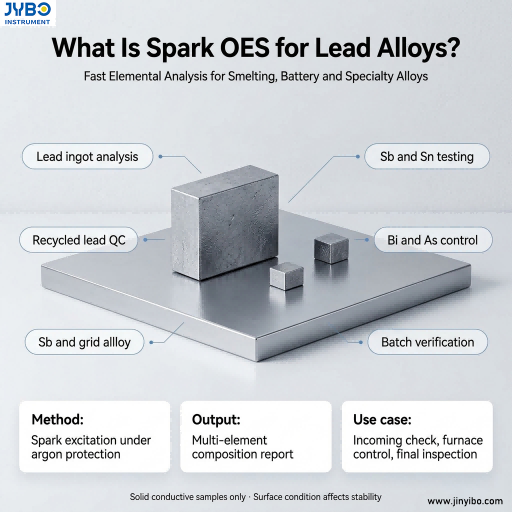
Under high-purity argon protection, high-voltage spark discharge excites atoms on the lead alloy surface. Each element emits unique spectral lines; the spectrometer detects spectral intensity and converts it into precise element concentrations via calibrated lead-matrix curves and matrix correction algorithms.
The core testing process includes three steps:
- Spark Excitation: Vaporize and excite sample surface atoms with argon shielding to eliminate oxidation interference.
- Spectral Collection: Disperse complex spectra and capture exclusive wavelength signals for target elements.
- Quantitative Calculation: Correct spectral overlap and matrix effects to output accurate component data.
Complying with GB/T 4103.16-2009, Spark OES detects major elements (Sb, Ca, Sn, Ag, Al) and trace impurities (Bi, As, Cd, Zn, Ni, Cu) in lead substrates.
Key Industrial Applications
Spark Spectrometer covers the full lead industry chain, including raw material inspection, furnace front process control and finished product verification.
Primary & Recycled Lead Smelting
It enables real-time impurity monitoring for crude and refined lead, quickly grading lead ingots and guiding furnace decontamination. For recycled lead production, it stabilizes smelting formulas and resolves raw material composition fluctuations.
Battery Manufacturing (Core Scenario)
Battery grid performance depends on precise Ca, Sn and Sb content control. On-site Spark OES testing avoids component deviation, reduces early battery failure rates, and supports batch sampling for finished grid castings.
Special Lead Alloy Production
- Lead-tin/lead-silver solders: Stabilize component ratios and impurities for reliable welding performance.
- Shielding & counterweight parts: Verify alloy purity and mechanical stability.
- Cable lead sheaths: Optimize Sb/Sn content for improved creep and aging resistance.
- Industrial lead-silver anodes: Monitor composition to extend service life.
Quality Dispute & Failure Analysis
OES spark spectrometer provides fast, credible component screening for supplier-buyer quality disputes. It also identifies alloy brittleness, corrosion and performance degradation caused by excessive trace impurities.
Testing Best Practices
Soft texture and high oxidation sensitivity make standardized operation critical for accurate, repeatable lead alloy OES results.
Sample Preparation
Avoid abrasive grinding to prevent particle contamination. Use lathe/milling turning to create a flat, metallic surface. Clean oil and oxidation with ethanol and test immediately to avoid re-oxidation.
Argon & Environmental Control
≥99.996% high-purity argon is required. Impure argon causes unstable spark discharge and spectral drift. Ensure sufficient gas pre-purging to eliminate air interference in the excitation chamber.
Instrument Calibration
Use lead-matrix standard samples for curve calibration to eliminate matrix effects. Perform daily drift correction and insert control samples during batch testing. Use blank excitation to eliminate memory effects between high/low concentration samples.
Advantages & Limitations
Core Advantages
- Rapid detection: Full multi-element analysis within 20 seconds for high-frequency QC.
- Cost-effective & eco-friendly: No chemical reagents or sample digestion required.
- High repeatability: Stable data for conventional and trace elements in lead alloys.
- On-site compatible: Ideal for workshop furnace front and factory laboratory use.
Limitations
- Only valid for conductive solid block samples (unsuitable for powder, debris or porous materials).
- Ultra-trace ppb-level impurities require complementary ICP testing.
- Segregated castings require multi-point testing for representative results.
Conclusion
Spark OES is a vital rapid detection technology for the lead alloy industry. It solves the low-efficiency and high-cost pain points of traditional wet chemistry methods, delivering fast, stable and standardized QC solutions for smelting, battery manufacturing and special alloy production. As recycled lead industry standards tighten, Stationary Metal Analyzers will remain a core tool for intelligent inspection and batch quality stabilization.
FAQ
Q1: What elements can Spark OES detect in lead alloys?
It covers major alloying elements (Ca, Sb, Sn, Ag) and harmful trace impurities (Bi, As, Cd, Zn, Ni, Cu), fully compliant with industrial testing standards.
Q2: What causes unstable OES test data for lead alloys?
Common factors include surface oxidation, unqualified sample flatness, insufficient argon purity and instrument drift. Standardized preparation and daily calibration effectively resolve data fluctuation.
Q3: Is Spark OES suitable for recycled lead batch testing?
Yes. It is the optimal solution for recycled lead smelting, supporting real-time formula adjustment and consistent batch quality control.
Please contact us for further inquiries or detailed information!
Tel:+86-183-5283 6805
Email:sales@jinyibo.com
Web:www.jinyibo.com